Last updated on: March 10, 2026
Key Takeaways
- The “Pop” Protocol: Pulley injuries (A2 and A4) occur when the flexor tendon “bowstrings” away from the bone under the force of a crimp. H-Taping is the clinical gold standard for supporting these pulleys during your return to the wall.
- Why the “H” Shape Wins: Unlike standard circular wrapping, the H-Tape creates a mechanical “bridge” over the knuckle. Scientific studies (Dr. Isabelle Schöffl, 2007) prove this shape reduces tendon-to-bone distance significantly more effectively than simple loops.
- Compression & Mobility: The H-Tape physically pushes the tendon back toward the bone while allowing the joint to remain mobile. This distributes the load away from the injured ligament, letting you climb with reduced risk of further tearing.
- Precision over Pre-Cuts: Avoid pre-cut 8mm strips. To create a true H-Tape, you need a solid central bridge. Using 25mm Rigid Tape allows you to tear custom “legs” while keeping the structural integrity of the center intact.
- Flexion is Essential: For the tape to be effective, it must be applied while the finger is slightly bent (approx. 60 degrees). This ensures that when you move your hand into a grip, the tape provides maximum tension exactly where the pulley needs it.
- Clean Hands, Better Stick: Chalk and skin oils are the enemies of adhesive. Always clean your fingers before applying tape to ensure it doesn’t slide off during a high-intensity bouldering session or crux move.
If you are a climber, you know the sound. The sickening “pop” followed by immediate regret.
If you are looking for a more general guide for Hand Taping, check out our Ultimate Guide on Hand Taping blog.
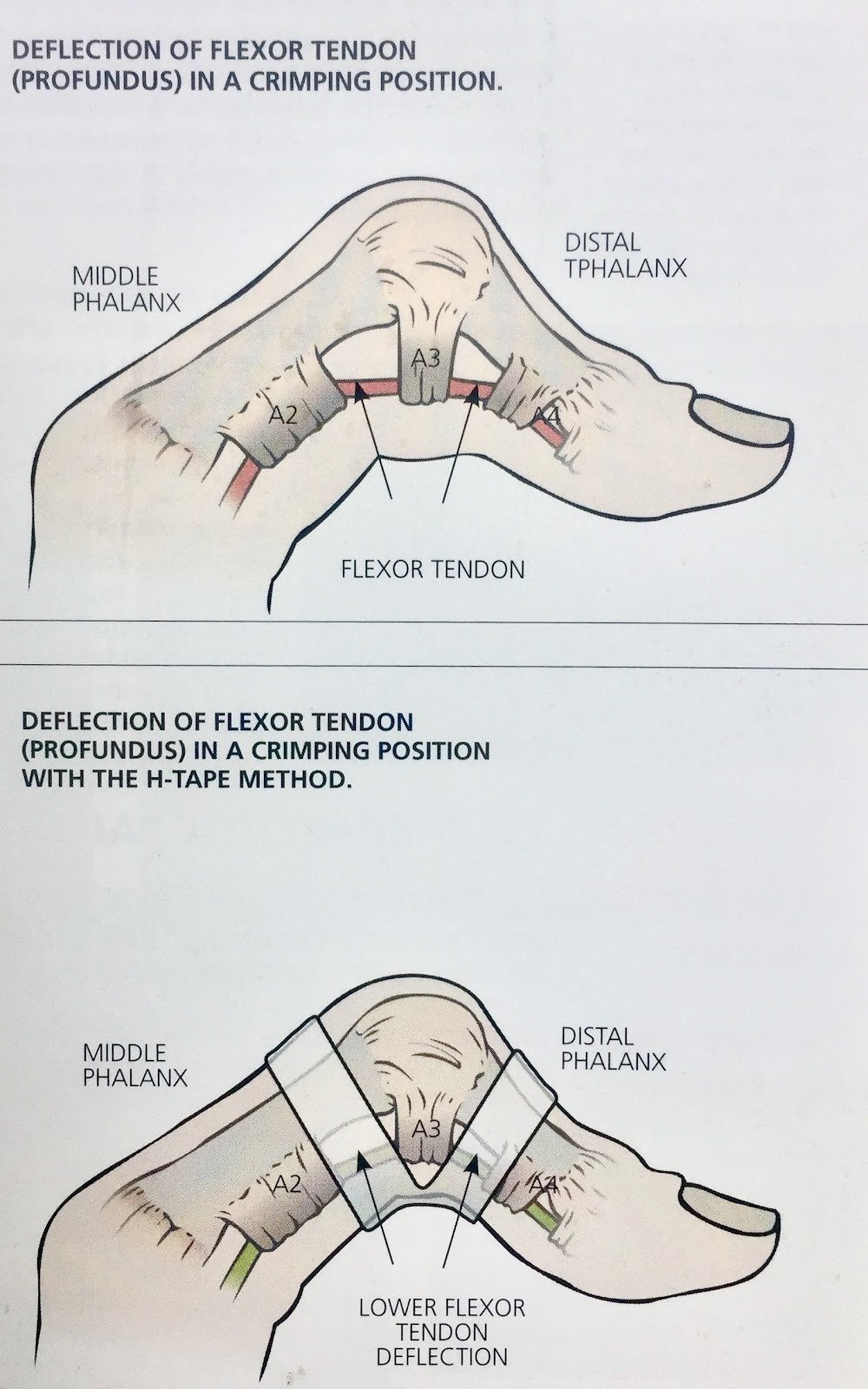
Pulley injuries (specifically to the A2 and A4 pulleys) are the most common traumatic injuries in rock climbing and bouldering. They happen when the force of a crimp causes the flexor tendon to bowstring away from the bone, tearing the ligament that holds it in place.
While rest is the only true cure for a rupture, H-Taping is widely considered the gold standard for supporting a healing pulley while you transition back to the wall.
In this guide, we’ll look at the H-Taping climbing method, why it works better than a simple loop, and how to do it correctly.
H-Taping Climbing: Why This Shape?
For years, climbers just wrapped tape in a circle around their finger (circumferential taping). However, research cited by physical therapists suggests that simple circles might not provide enough mechanical support to the pulley system.
This method isn’t just climbing folklore; it is backed by biomechanical data. We draw our protocols from the experts at Grassroots Physical Therapy and the landmark 2007 study by Dr. Isabelle Schöffl, which demonstrated that H-taping significantly reduces “tendon-bone distance” (bowstringing) more effectively than standard circular taping.
By creating a “bridge” of tape over the knuckle (PIP joint), you apply tension to both the proximal and middle phalanx bones simultaneously.
The Benefits:
- Force Distribution: It transfers the load away from the injured pulley.
- Tendon Compression: It physically pushes the tendon closer to the bone, reducing the “bowstring” effect that causes pain.
- Mobility: Because the tape crosses around the knuckle rather than over it, you maintain better range of motion than with bulky “X-taping.”
The H-Taping Method (Step-by-Step)
Based on the standard protocol used by climbing physios.
What You Need: You don’t need special thin climbing tape for this. In fact, a wider roll is better. We recommend Pillar Sports 25mm Rigid Tape because you need to customize the width of the “legs” of the H.
Preparation: Clean your hands. Chalk and grease prevent adhesion.
Here’s a step-by-step guide on how to apply an H-tape for pulley injuries, as demonstrated in the video:
- Prepare the tape: Take a piece of tape about 8 centimeters long and about an inch wide (0:46).
- Create the “H” shape: Tear the tape from both sides up to the middle so it forms an “H” or “X” shape (0:53-1:03).
- Position the tape: Place the “X” part of the tape directly onto the finger joint (1:16-1:22).
- Tighten distant straps: Pull the distant straps of the tape tight. You can make these a bit tighter than the other strips (1:22-1:29).
- Flex the finger: Bend your finger at about a 60-degree angle (1:31-1:41).
- Flex proximal strips: While keeping the finger flexed, also flex the proximal strips of the tape (1:41-1:45).
- Cover with circulation crosswise: Cover the applied H-tape with another circulation of tape wrapped crosswise. This helps secure the tape and prevents edges from lifting (1:51-1:59).
It’s important to apply the tape while your finger is in flexion (2:10-2:19), as this helps bring the pressure to the A3 pulley.
The Result: You should see the “bridge” sitting on your knuckle, while the legs tightly compress the segments above and below it. This acts as an external pulley system.
Why 25mm Tape is the Climber’s Secret Weapon
Many climbers waste money on pre-cut 8mm strips. The problem? You can’t make a true H-Tape with pre-cut strips because you need that solid connected bridge in the center.
With Pillar Sports 25mm Rigid Tape, you have the perfect width to create the bridge and the split legs in one single piece. It is the most versatile roll in your crag bag.
Sources: