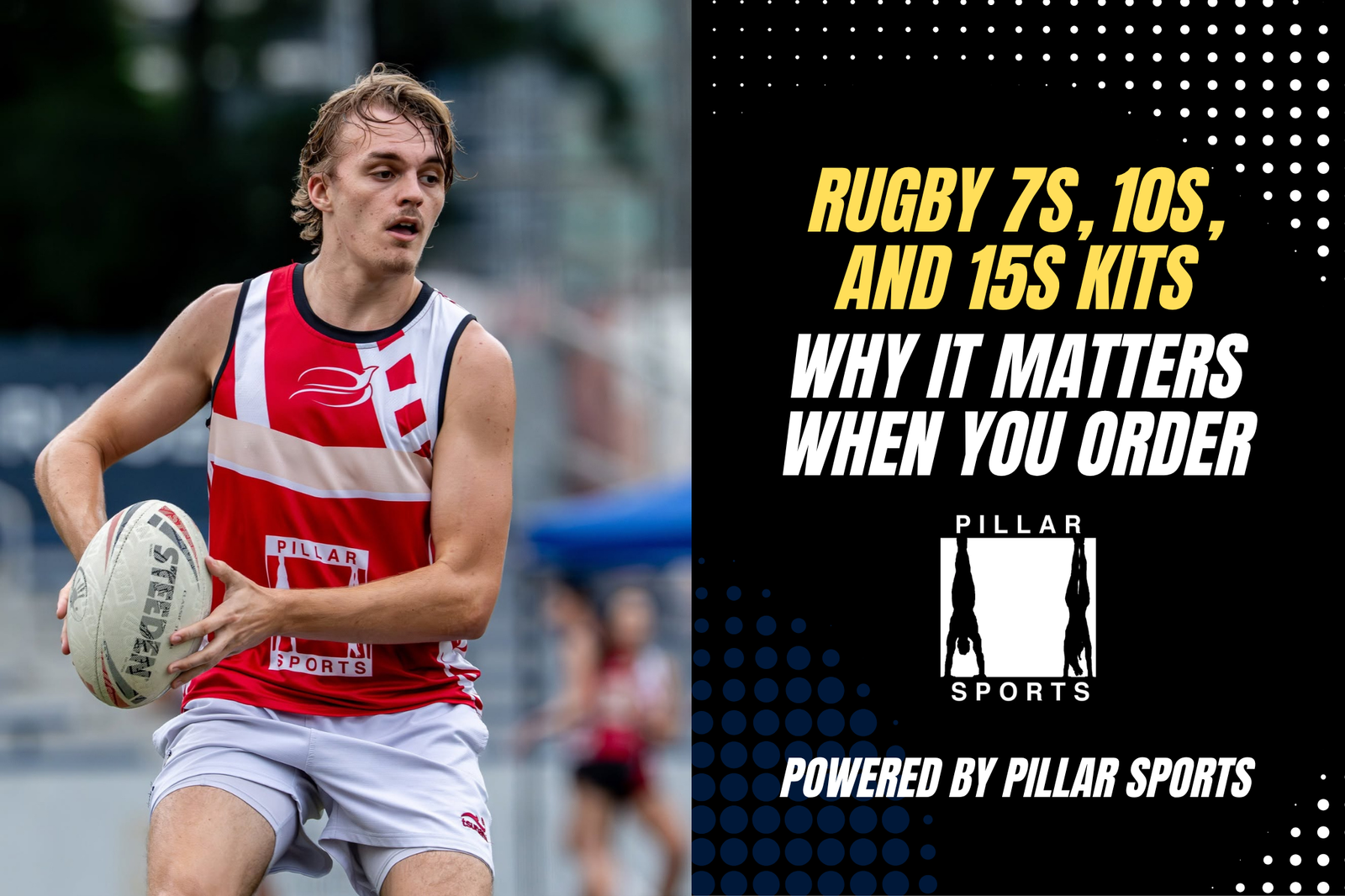
A lot of clubs around the world play more than one format. You might have a full 15s season squad, a handful of players who enter the Tens circuit in the middle of the year, and a 7s side that shows up at every invitational going. Same club, same colours — but the kit requirements are not always the same.
The question we get asked regularly when clubs come to us about a custom rugby kit order: “Can we just use the same jersey across all three?” Sometimes yes. Often no. And the reason matters more than you might think.
This guide breaks down what actually differs between 15s, 7s, and 10s kit — and what that means for how you plan your order.
Why Rugby Format Changes What You Should Order
The three formats of rugby share the same ball and the same try line, but they put different demands on the body and on the kit. Contact volume, movement patterns, squad size, and tournament structure all vary — and each of those factors has an effect on what your teamwear needs to do.
This is not just a technical detail. Getting it wrong means kits that wear out too fast, squads that show up to a tournament without the right gear, or orders placed too late to arrive in time. Understanding the differences upfront saves real headaches down the line.
How to Order Custom Sports Uniforms
Rugby 15s Kit: Built for a Season, Not a Weekend
15s is your standard season format. Weekly competition, heavier contact, more physical demands on the jersey — especially for forwards.
What the Kit Needs to Do
15s kits take more punishment than any other format. Scrums, mauls, rucks, lineout lifting — the collar, shoulder seams, and side panels all face regular stress across a full season of games and training.
For forward-heavy squads, features like reinforced collar construction and grip panels on the shoulder are not cosmetic — they are functional. A jersey without reinforcement at the collar will start separating after a season of scrums. That is a quality problem, but it is also a fitting problem: forward jerseys and backs jerseys are typically cut differently.
Durability is the primary specification for 15s kit. You are ordering something that needs to hold up across a domestic season that can run five to seven months. Fabric weight, stitch construction, and panel bonding all matter more here than they do in shorter formats.
Timeline Considerations
15s seasons in Hong Kong typically kick off in October and run through March, giving clubs a clear pre-season runway over the mid-year months. Singapore club calendars follow a broadly similar rhythm, though it’s worth confirming exact dates with your union each year.
Standard lead time for custom 15s teamwear runs eight to twelve weeks from artwork approval. If your season opens in early October, your order should be placed no later than late July or early August. Most clubs that run into problems leave it until September and then manage the stress of chasing delivery in the week before the first match.
💡 Pro Tip: If you have forwards and backs in noticeably different jersey sizes, flag this early in your order. Multi-cut custom orders take slightly longer to produce than single-cut runs, and it is better to know this before you set your deadline. Regular fit for the big boys and athletic fit for the slim.
Rugby 7s Kit: Lighter, Faster, and Often Required as a Full Bundle
7s is a different animal. Less contact, more running, shorter bursts of intensity — and a tournament structure that compresses everything into a weekend.
What the Kit Needs to Do
7s kit is typically cut lighter and with a more athletic fit than 15s. The fabric weight drops, the cut through the torso is slimmer, and there are no collar reinforcements needed — because the scrum involvement is either minimal or eliminated entirely. What you want is a jersey that does not create drag, does not trap heat, and moves with the player rather than against them.
The backs cut used in 7s suits the full squad in this format. Everyone is running. Even the loosies need the same freedom of movement as a winger.
Tournament Registration Requires a Full Bundle
Here is the part that catches clubs off guard: most 7s tournaments require teams to register with a matching kit — jersey, shorts, and socks in matching club colours. If you show up with matching jerseys and mismatched shorts, you may be asked to change or risk a penalty.
For clubs ordering 7s teamwear, this means the order is almost never jersey-only. Plan for a full bundle: jersey, shorts, and socks, all produced in matching sublimation or the same colour specification.
🎯 This is especially relevant for clubs entering the Hong Kong Tens, Asia Rugby Sevens Series events, or any invitational where tournament officials check kit compliance at registration.
Deadline Pressure Is Real
The 7s tournament calendar in Asia tends to cluster. The Hong Kong Sevens, regional invitationals, and corporate 7s events all fall in relatively tight windows. Unlike 15s, where you have a clear pre-season runway, 7s entries can come with short notice — especially invitationals.
This means 7s kit orders need to move fast once a tournament is confirmed. If you leave it until the entry is accepted, you may already be inside your lead time window. The safest approach is to have 7s kit either ordered in advance or held in stock after your main 15s order.
For a full breakdown of how to approach the 7s order process, see [LINK: Spoke 5 — Rugby 7s Kit blog].
Rugby 10s Kit: The Format That Most Clubs Under-Order For
10s is the most underserved format when it comes to kit planning — and that is partly because the format itself is still gaining traction in Asia.
What the Format Looks Like
10-a-side rugby has been growing steadily in the region, driven mainly by independently run club and social tournaments rather than a single governing body series. The Hong Kong Tens (now the Tradition HKFC 10s) is one of the most established events of its kind in Asia, and similar Tens tournaments — from Manila to Pattaya — have been added to club calendars across the region in recent years. Squad sizes are smaller than 15s, larger than 7s, and the game plays more like 7s in terms of running intensity — while still including structured set pieces.
If your club is entering a Tens event, there is a good chance you are drawing from your main squad. The question is: which kit do you wear?
Can You Use Your 15s or 7s Kit?
Often yes — with some caveats.
If your 15s kit is a reasonably athletic cut and the fabric is not too heavy, it will function adequately in a Tens format. If your 7s kit is cut close and light, it works even better. The main issue comes when clubs have very forward-heavy 15s jerseys with reinforced collars and grip panels — these are physically heavier garments and less comfortable for a running-focused format.
The practical answer: if you have a 7s kit already, use it for Tens. If you only have a 15s kit, it will do the job, but be aware it was not designed for that level of running intensity.
Where clubs start to consider ordering specific 10s teamwear is when:
- They enter Tens events regularly enough to justify a dedicated kit
- They want to protect their main 15s kit from wear at non-season events
- The Tens tournament has its own kit compliance requirements
Squad Size Planning
One thing that catches clubs out: Tens squads are typically 14–16 players with limited replacements. That is smaller than a 15s touring squad, but bigger than a 7s squad. If you are ordering kit specifically for a Tens event, size your order accordingly rather than pulling from your 15s stock and running short.
Can You Use One Kit Across All Three Formats?
Realistically — yes, in many situations. But there are trade-offs.
| Scenario | Works? | Trade-off |
| 7s kit used for Tens | Yes | Best option if cut is athletic and light |
| 7s kit used for 15s | Generally no | Too light for contact, no forward-specific features |
| 15s kit used for Tens | Yes, with caveats | Heavier fabric, less ideal for high-running formats |
| 15s kit used for 7s | Possible, not ideal | Weight and cut will affect running comfort |
| One kit across all three | Rare — only if kit is well-designed for versatility | Compromise on durability or performance in at least one format |
For most clubs, the practical solution is a 15s kit as the primary investment and a separate 7s/Tens bundle for the tournament circuit. That approach keeps your season kit in good condition and ensures you meet tournament registration requirements.
How to Plan Your Order If You Play Multiple Formats
If your club runs across formats, here is a straightforward way to think about your ordering plan:
1. Anchor on your 15s season first. This is your largest order, it has the longest lead time, and it sets your brand identity. Get this in motion at least ten weeks before your season opener.
2. Decide whether 7s and Tens share a kit. If your 7s and Tens participation overlaps in timing, a single lightweight bundle can serve both. Confirm whether the tournament regulations for both events are compatible with the same kit specification.
3. Factor in squad size differences. Do not order your 7s bundle in the same quantities as your 15s order. 7s squads typically need fewer jerseys; Tens squads sit in between.
4. Build in lead time for each entry point. If you enter a 7s invitational with four weeks’ notice, you are inside standard production time. Talk to your kit supplier early — even before confirmation — so that production can begin the moment the entry is accepted.
For clubs starting a new kit order from scratch, [LINK: Spoke 1 — Custom Rugby Kits blog] covers what to include in your brief and how to structure a full club kit order.
Ordering in Hong Kong and Singapore
Pillar Sports works with clubs across Hong Kong and Singapore across all three formats. Whether you need a custom rugby jersey for a full 15s season squad, a tournament-ready 7s bundle, or a short-run Tens kit for a specific event, we can advise on the right specification for what you are playing and when you need it.
The earlier you come to us, the more options you have — on materials, print method, and timeline. Last-minute rush orders are manageable, but they limit your choices.
Start your Order for Custom Rugby Kits
Final Thoughts
The biggest mistake clubs make when ordering across formats is assuming the kit is interchangeable and ordering too late to course-correct when it is not. A 15s jersey built for scrum reinforcement was not designed for a 7s tournament. A 7s kit ordered the week before an event was not designed for your production timeline.
Know what format you are ordering for, plan your timelines accordingly, and if you are in doubt about what specification suits your format, ask before you finalize the brief — not after the jerseys arrive.
If you are putting together a custom rugby kit order and want to talk through the right approach for your club’s mix of formats, get in touch with the Pillar Sports team. We are based in Hong Kong and Singapore, and this is exactly what we help clubs work through.
Sources
- https://hkfc-10s.com/